
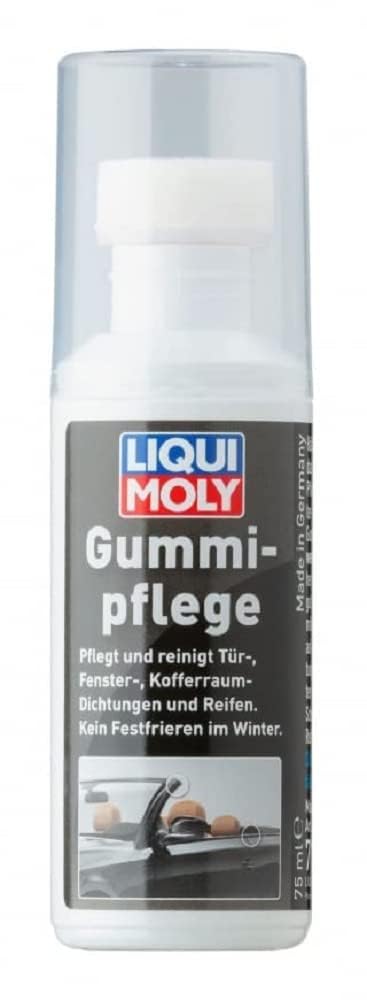
LIQUI MOLY Trattamento per gomma, 75 ml, Cura della macchina, SKU: 7182
You save €0,54
Free shipping across Italy
In stock
Product data
- Brand
- Liqui Moly
- Category
- Cleaning agent
- SKU
- B00CSYM1K8
- EAN
- 4100420219269
- Weight
- 0.22 lb
Marca: Liqui Moly
Colore: Neutro
Caratteristiche:
- Particolarmente adatto per il trattamento, la protezione e la preparazione della superficie dei componenti in gomma, ad esempio dei pneumatici, delle guarnizioni in gomma delle portiere, dei tappetini e altro ancora, nei veicoli a motore
- L'imballaggio può variare
Dettagli: Tratta, pulisce e migliora l'aspetto delle portiere, dei vetri, dei parafanghi e dei pneumatici. Impedisce che si congelino in inverno. Mantiene i componenti in gomma elastici e ne prolunga la durata. Ottimo anche per il trattamento e la pulizia in profondità dei pneumatici e dei tappetini in gomma. L'imballaggio può variare
EAN: 4100420219269
Data di rilascio: 13-10-2019
Dimensioni del pacchetto: 4.5 x 1.4 x 1.4 inches
Le lingue: Italian, German, French, English, Spanish
Codice articolo: P001132
Numero modello articolo: 7182
Specification.
Always confirm against your vehicle handbook before ordering.
- Brand
- Liqui Moly
- Category
- Cleaning agent
- SKU
- B00CSYM1K8
- Weight
- 0.22 lb
- Availability
- In stock
Goes with this.


Get it right the first time.
How to read an oil label
Viscosity, ACEA class and OEM approval — what each part of the label actually tells you.
Read guide WinterWhat the W in 5W-30 means
The cold-flow rating, and why a lower W protects the engine on a cold start.
Read guide StandardsACEA vs API, explained
The European and American performance classes, and how to match them to your handbook.
Read guideQuestions, answered.
How do I know which viscosity my car needs?
Check the owner's manual or the oil filler cap. It states the required viscosity grade (for example 5W-30) and the manufacturer approval. Match both and you are within specification.
What do the two numbers in 5W-30 mean?
The first number with the W is the cold-flow rating: lower stays thinner at low temperature, so oil reaches the bearings faster on a cold start. The second is viscosity at operating temperature. Both are defined by the SAE J300 standard.
What are ACEA and API classes?
Performance standards, not viscosity ratings. ACEA is European (for example C3 for engines with a particulate filter), API is American (for example SP for modern petrol engines). Your handbook lists the required class.
What are the delivery and return terms?
Our shipping and refund policies are linked in the footer and at checkout. Those pages are the binding terms for every order.
Not sure this is the right spec?
Send us your plate or engine code and we will confirm the correct grade and approval before you order.